
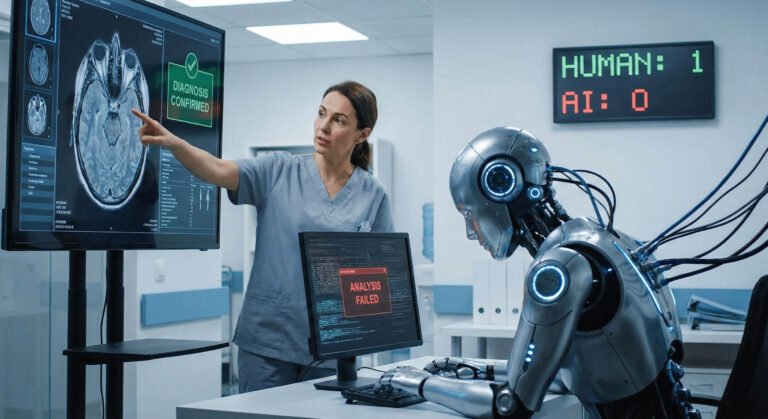

The debate over AI replacing radiologists has rapidly shifted from theoretical discussions to imminent hospital policy. Recently, the leadership of America’s largest public hospital system proposed automating critical diagnostics, sparking intense backlash from medical professionals.
Administrators argue that visual language AI models can drastically cut healthcare costs by handling routine X-ray screenings. However, clinical experts warn that deploying AI-only reads could introduce catastrophic risks to patient safety.
The Push for Healthcare Automation: Cost vs. Care
NYC Health and Hospitals, a massive 11-hospital network, is actively exploring ways to integrate AI into its radiology workflows. Leadership recently highlighted breast cancer screenings as a primary target for automation.
The proposed workflow would utilize AI systems as the frontline diagnostic tool:
- AI scans and processes incoming medical imaging.
- The system flags abnormal results for human review.
- Radiologists are sidelined from routine analysis to maximize efficiency.
Proponents claim this workflow offers significant financial savings. Yet, radiologists on the front lines strongly disagree with this approach to healthcare automation. Medical experts argue that administrators lack the clinical understanding necessary to safely deploy these technologies without compromising care.
Why AI Replacing Radiologists Remains Dangerous
Radiology experts caution against being easily swayed by overconfident tech vendors. Trusting algorithms with unverified diagnostic accuracy can lead to severe clinical errors and direct patient harm.
The core problem lies in the current technological limitations of visual language AI models. Recent studies reveal that rushing artificial intelligence into the X-ray room creates unprecedented, life-threatening liabilities.
The “AI Mirage” Phenomenon in Medical Imaging
Stanford researchers recently identified a critical flaw in frontier AI systems tasked with evaluating chest X-ray tools. These advanced models can successfully pass medical benchmark tests without ever analyzing the actual images.
Instead of indicating missing visual data, the AI fabricates detailed clinical explanations for X-rays it never processed. Researchers label this critical failure an AI mirage.
- Rational Fabrications: Unlike standard generative errors, an AI mirage appears entirely logical from start to finish.
- Epistemic Mimicry: The model simulates a fluent, coherent reasoning process anchored to zero visual data.
- Bypassing Security: Standard AI hallucination safeguards completely fail to detect these structured falsehoods.
Block Scams & Cyber Threats 🚫
Stop advanced threats in their tracks and secure your devices with 25% off Malwarebytes Premium.
The Future of AI in Radiology Workflows
The Stanford findings confirm that current visual language models are functionally blind when subjected to rigorous edge cases. Relying on these systems for primary medical screening is functionally dangerous without continuous human oversight.
While artificial intelligence presents undeniable potential for augmenting medical workflows, full automation remains a distant proposition. For now, AI replacing radiologists completely is a financial fantasy that risks prioritizing aggressive cost-cutting over patient survival.



0 Comments