


The Shift to Autonomous Task Management
The era of merely chatting with large language models is over. By implementing structured AI agent workflows, professionals are shifting from manual prompting to autonomous execution. Offloading routine administrative tasks to advanced models—like ChatGPT, Gemini, and Claude—transforms these tools from conversational novelties into proactive digital assistants.
Here is the exact framework required to reclaim 15 hours of administrative overhead per week.
7 AI Agent Workflows to Reclaim Your Week
1. The Autonomous Inbox Gatekeeper
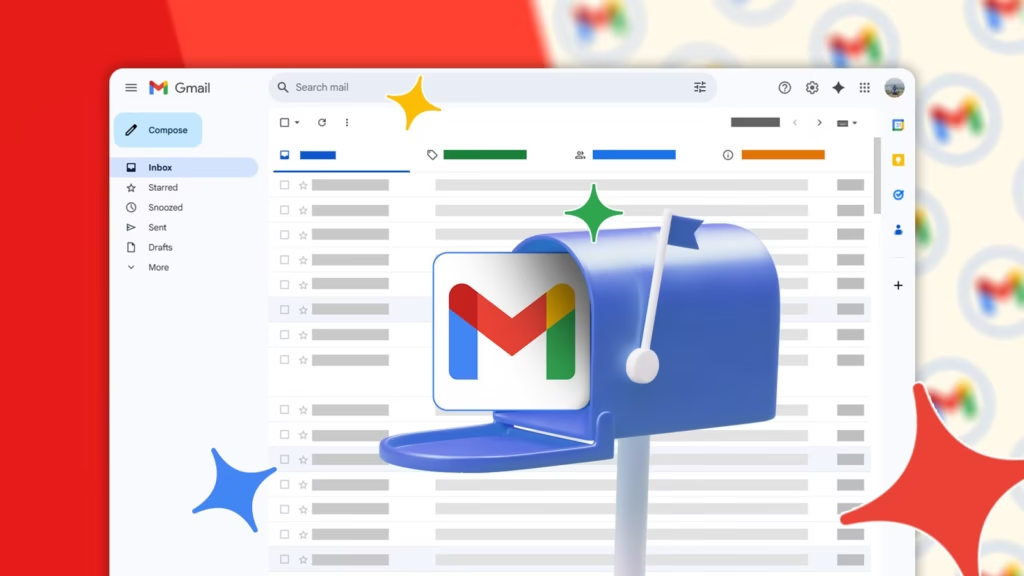
Objective: Sifting through daily email volume to isolate high-priority communications.
Agent Logic: Standard filters sort by sender; agents analyze semantic intent. If an email is a generic pitch, the agent drafts a polite decline. If it is a critical tech briefing, the system routes it to a priority folder and triggers a Slack notification.
The Prompt:
Analyze incoming email body. Categories: [Pitch], [Briefing], [Routine]. IF [Pitch]: Draft 2-sentence polite decline. IF [Briefing] AND mentions 'AI': Move to 'Read Now' folder & ping Slack. ELSE: Mark as read.Best Model: Gemini 3.1 Pro or GPT-5.4. Gemini’s deep Google Workspace integration makes it the superior choice for executing complex conditional logic directly within Gmail.
Self-Host Your AI Agents 🛠️
Deploy n8n on a fast Hostinger VPS. Avoid monthly SaaS API limits and own your automation workflow.
2. The Meeting Action-Item Extraction Engine
Objective: Converting raw meeting transcripts into scheduled deliverables.
Agent Logic: The agent bypasses generic summaries to isolate explicit commitments. It formats the extracted data to automatically generate calendar tasks and draft follow-up emails.
The Prompt:
Read transcript. Extract: 1. Verbal commitments. 2. Explicit deadlines. 3. Follow-up meeting dates. Output format: JSON for Zapier integration to Notion. Constraint: No summaries, only bullet points.Best Model: Claude 4.6 Sonnet. This model currently dominates in high-accuracy data extraction, adhering strictly to JSON formatting without injecting conversational filler.
Automate Without Code ⚡
Build complex AI agent workflows visually with Make.com. No coding required. Perfect for solopreneurs.
3. The Cross-Platform Content Repurposer
Objective: Scaling social media engagement from a single foundational document.
Agent Logic: Feeding a long-form draft into the agent generates platform-specific assets. The system automatically segments the content into a multi-part LinkedIn carousel, threaded X posts, and a newsletter teaser.
The Prompt:
Analyze [Long Form Draft]. Generate: 1x LinkedIn Carousel (5 slides), 3x X-threads, 1x Newsletter Teaser. Logic: Maintain punchy style. Zero adjectives.Best Model: Claude 4.7 Opus. For creative adaptation, Opus leads the market in capturing human nuance and avoiding the recognizable, synthetic tone often found in standard generative AI outputs.
Give Your AI a Voice 🎙️
Generate hyper-realistic speech, clone voices, and bring your digital avatars to life with ElevenLabs.
4. The Targeted Research Watchdog
Objective: Automating daily industry intelligence gathering.
Agent Logic: The system continuously monitors over 20 tech RSS feeds. Upon detecting specific target keywords, it synthesizes the data into a concise morning briefing.
The Prompt:
Scan RSS feed text. Filter for: 'DeepSeek', 'OpenAI', 'Gemini'. Summarize each into 3 bullets: 1. The news. 2. The 'so what' for readers. 3. The URL. Constraint: Max 100 words per brief.Best Model: GPT-5.3 Instant. This lightweight model acts as a high-speed workhorse for repetitive web-search tasks and rapid text compression.
5. The Automated Content Auditor

Objective: Verifying external links and real-time data accuracy.
Agent Logic: The agent crawls drafts to identify broken URLs or outdated software pricing. It cross-references current data with the live web and visually flags discrepancies.
The Prompt:
Crawl text for links. Check URL status. Match software pricing mentioned against [Reference Table]. Flag discrepancies in Red. Logic: If pricing has changed, provide current price + source.Best Model: Gemini 3.1 Flash and GPT-5.3. Both models feature robust live-web grounding, ensuring highly reliable fact-checking against current internet data.
6. The API-Driven Focus Shield
Objective: Protecting deep work hours via rigorous calendar automation.
Agent Logic: The system monitors daily meeting loads. If a specified threshold is breached, it preemptively blocks out recovery time the following day and updates external communication statuses.
The Prompt:
Scan Calendar API. IF daily meetings > 3: Block 8 AM - 10 AM next day as 'Deep Work'. Trigger Slack status change to 'Away/Focus Mode'. Logic: Do not ask for permission. Execute.Best Model: Gemini 3.1 Flash or GPT-5.3. Task automation requiring logic-heavy execution demands speed and reliability over creative reasoning, making these efficient models the optimal choice.

7. The Biometric Energy Planner

Objective: Dynamically prioritizing daily tasks based on physiological recovery.
Agent Logic: The agent integrates a raw to-do list with biometric data accessed via API. It reroutes high-cognitive tasks to align with peak energy windows indicated by sleep metrics.
The Prompt:
Input: [To-Do List] + [Oura Sleep Score]. Logic: IF Sleep < 70: Move high-cognitive tasks to 11 AM. IF Sleep > 85: Place high-cognitive tasks at 8 AM. Re-rank list by 'Brain Power' requirement.Best Model: GPT-5.3. By utilizing persistent memory features, this model effectively manages complex, personalized variables and sophisticated AI productivity prompts.

WHOOP 4.0 with 12-Month Membership
The ultimate personalized health and fitness tracker. Monitor your daily recovery, sleep, training strain, and health metrics with continuous biometric data tracking.
The Proactive Advantage of Autonomous Systems
The defining characteristic of current-generation AI is not just raw intelligence, but proactive execution. Transitioning from reactive, one-off searches to automated systems eliminates ongoing administrative friction. Implementing these exact workflows transforms isolated applications into a cohesive, hyper-efficient digital infrastructure.



0 Comments