

The New Development Paradigm: How to Make Money Vibe Coding
In November 2025, Maor Shlomo leveraged an AI agent stack in his Tel Aviv apartment to build Base44, a specialized app builder. He completely bypassed traditional syntax. Instead, he dictated feature specifications to Cursor and Claude, reviewed the resulting TypeScript, and deployed the software.
Three weeks post-launch, Base44 achieved $1 million in annual recurring revenue. By June 2026, Wix executed an $80 million cash acquisition for the platform. Shlomo had zero employees.
This is the operational reality of the modern tech stack. If you want to make money vibe coding—the industry term for generating functional software through natural language prompts—you must separate the social media hype from actual revenue mechanics.
Coined in a February 2025 post on X by former Tesla AI chief and OpenAI co-founder Andrej Karpathy, the term was subsequently named Collins Dictionary’s Word of the Year. In 2026, it transitioned from a technical novelty into a high-yield business model.
However, the highest-margin operations are not selling tutorials or posting on social media. They are deploying internal dashboards, invoicing tools, and booking agents to solve mundane, high-friction problems for specific B2B clients. The gap between the hype machine and actual cash flow is wide, requiring a strategic approach to navigate successfully.
The Vibe Coding Executive Brief: Quick Answers

How much can you make vibe coding?
Income brackets vary significantly based on deployment models. Casual builders selling simple utilities average $600/month. Experienced operators running micro-SaaS products or freelancing at $100 to $350/hour routinely clear $20,000+/month. Industry data reveals the median successful micro-SaaS reaches $1,200 in monthly recurring revenue (MRR) within 90 days.
Do you need to know how to code to make money vibe coding?
No. According to Indie Hackers, 34% of new micro-SaaS products launched in Q1 2026 were built by founders with zero prior programming experience. Lovable app builder, Bolt.new, and Replit Agent automate the AI code generation. Success requires product-market fit and clear problem articulation, not syntax memorization.
What’s the fastest way to make your first dollar vibe coding?
Target local businesses with custom tooling. Dental offices, real estate agents, and boutique retailers require specialized lead capture forms and dashboards but cannot justify enterprise software contracts. A single setup contract commands $500 to $3,000, and the entire system can be spun up over a weekend using Lovable or Cursor AI.
Automate Without Code ⚡
Build complex AI agent workflows visually with Make.com. No coding required. Perfect for solopreneurs.
Revenue Realities: How Much Do Vibe Coders Actually Make?

The unvarnished truth is that the majority of entrants make nothing. A highly-trafficked post on r/vibecoding titled “99% of vibe coders will never make a dollar” garnered 482 upvotes by highlighting the massive friction between shipping a weekend project and actually acquiring paying users.
However, operators who crack distribution are pulling significant capital. Data from VibehHackers.io confirms that freelance AI developers charge between $100 and $350 per hour. They command these premiums because they deliver functional, deployed software exponentially faster than traditional engineering teams. In the corporate sector, full-time “vibe coder-AI engineer” roles at aggressive startups offer base salaries of $150,000 to $200,000, plus equity.


The micro-SaaS trajectory presents a much wider distribution curve. A comprehensive RockingWeb analysis of over 1,000 AI-generated businesses found that 70% stall under $1,000 per month. Only 1 to 2% break the $50,000 per month threshold.
Crucially, the median successful product—defined as one that secures active, paying users—reaches $1,200 MRR within 90 days. That 90-day benchmark is a completely new paradigm.
Prior to mature AI integration, building a SaaS took months of capital-intensive development. Today, leveraging Cursor ($20/month Pro), Lovable ($25/month Starter), or Replit Agent, a solo operator can go from ideation to production in under 72 hours. The cost floor has collapsed, and the speed ceiling has vanished. The only remaining hurdle is distribution.

Beyond Vibe Coding: The AI Era Developer
Master AI-assisted development. Learn the exact frameworks to scale, architect, and engineer robust software faster than ever.
7 Proven Business Models to Monetize Vibe Coding in 2026
Not all monetization paths offer the same leverage. Some scale infinitely, while others require high-touch sales workflows. Here is the empirical data on what is actively converting in 2026.
1. Freelance Custom Builds for Small Businesses
This is the lowest-friction entry point and the most reliable cash-flow generator. Plumbers need estimate calculators; yoga studios need bespoke booking pages; real estate agents need lightweight CRMs avoiding $200/month overheads.
Freelancers bridge this gap, deploying functional tools in days. Billing ranges from $50/hour for basic utility apps to $350/hour for complex API integrations and database architecture. Implementing monthly maintenance retainers of $50 to $100 per client secures stable recurring revenue. The bottleneck here is strictly client acquisition, not technical execution.
2. Micro-SaaS Subscriptions
This model offers the highest asymmetric upside coupled with the highest failure rate. The modern playbook mandates extreme niche selection. Do not build a generic CRM; build an inventory tracker specifically for indie bookstores or a menu builder for food trucks.
Ben Broca demonstrated the velocity of this model. Operating his company Polsia from a San Francisco apartment with zero staff, he utilized an AI agent stack to hit $1 million ARR in 30 days. By the end of February 2026, revenue tripled to $3 million.
While Polsia is an outlier, the top 10% of micro-SaaS products reach $5,000+ MRR. Success hinges entirely on identifying a hyper-specific, painful workflow and pricing the solution correctly.
Build Your AI Sales Team 🤖
Stop manually replying to leads. Deploy SmartAgents to handle objections, qualify prospects, and book meetings directly to your calendar 24/7.
3. AI Agents for Local Businesses
This is currently the highest-margin, lowest-visibility strategy in the ecosystem. Service businesses—HVAC companies, law firms, property managers—bleed operational hours on manual appointment confirmations, invoice reminders, and review requests.
Vibe coders engineer AI agent setups to automate these specific workflows. Pricing structures generally land at $500 to $3,000 for initial deployment, followed by $200 to $500/month for ongoing management.
One documented case study involves a builder deploying booking agents for dental clinics: charging a $3,000 setup fee and $300/month. Scaling to just eight clients yields $2,400/month recurring, alongside $24,000 in front-end setup fees within the first year.
Give Your AI a Voice
Generate hyper-realistic speech, clone voices, and bring your digital avatars to life with ElevenLabs.
4. Template and Starter Kit Sales
For developers focused on scalable digital products, packaging reusable codebases is highly lucrative. Next.js SaaS starter templates frequently sell 40 to 80 copies monthly at $49 on marketplaces like Gumroad and LemonSqueezy, yielding $2,000 to $4,000/month with zero marginal cost.
Because the market is increasingly saturated, 2026 demands hyper-specific templates. “AI-powered appointment system for salons” justifies a $79 to $149 price tag, outperforming generic $29 starter kits by targeting distinct buyer intent.
5. Educational Content and Community
The ecosystem is expanding rapidly, creating a massive top-of-funnel audience looking for guidance via YouTube, blogs, and paid courses.
The caveat here is market irony: many creators generate their primary income from the content, not from deploying code. To succeed ethically and profitably, specificity is your moat. A case study titled “How I built a booking system for veterinary clinics and got 12 paying customers in 6 weeks” will universally outperform generic AI monetization lists.

Organise Your Life with ChatGPT (2026)
The ultimate blueprint to automate daily chaos and reclaim 10+ hours a week using advanced AI workflows.
6. Internal-Tool Consulting
Enterprise and mid-market employees are frequently bottlenecked by legacy spreadsheet workflows. Vibe coders are bypassing bloated IT departments, directly pitching department heads to automate complex processes in days.
A 2026 New Stack report highlighted executives who are now bypassing IT to generate their own internal tools. As one executive noted, “I was tired of explaining it to somebody who was supposed to build it for me.” Consultants command project rates of $2,000 to $10,000, benefiting from rapidly accelerated B2B sales cycles.
7. Ad-Supported and Freemium Simple Apps
This is the lowest-margin, lowest-effort tier. Deploying utility apps—recipe converters, workout timers—monetized via programmatic ads or freemium unlocks rarely yields more than $50 to $200/month. However, it serves as an excellent low-stakes environment for learning deployment pipelines.
Deployment Timelines: How Long Until Your First Dollar?

Time-to-revenue correlates directly with your chosen monetization vector. Custom freelance builds bypass product-market fit entirely, while SaaS models require patience.
| Path | Time to first dollar | Monthly income range | Best for |
| Freelance custom builds | 1-3 weeks | $1,000-$8,000 | People with sales skills and local networks |
| Micro-SaaS | 30-90 days | $0-$5,000+ (wide range) | Problem-finders with patience for iteration |
| AI agents for local biz | 2-4 weeks | $1,500-$5,000+ | Builders who understand service businesses |
| Template sales | 2-6 weeks | $500-$4,000 | Builders with marketing skills |
| Educational content | 1-3 months | $200-$3,000 | Clear communicators with a track record |
| Internal-tool consulting | 2-4 weeks | $2,000-$10,000/project | People with corporate connections |
| Ad-supported apps | 1-2 months | $50-$200 | Beginners learning the process |
Security and Liability: The Real Risks of AI Code Generation

The narrative surrounding rapid deployment frequently obscures critical vulnerabilities that can destroy client trust and trigger massive legal liability.
LLM generated code is inherently prone to security flaws. An audit by a prominent pen-testing firm analyzed 15 AI-generated applications, discovering 69 vulnerabilities—including six critical flaws exposing database access and session hijacking.
Escape.tech conducted a broader scan of 5,600 publicly deployed vibe-coded applications, uncovering 2,000 critical vulnerabilities, 400 exposed secrets (including live API keys), and 175 instances of exposed personal data, including medical records. Furthermore, Georgetown CSET identified XSS vulnerabilities in 86% of code samples across five major language models.
Beyond raw security, market dynamics pose risks. As deployment friction drops to zero, the race to the bottom accelerates. The developer charging $3,000 in January will face competitors charging $500 by December.
Additionally, maintenance debt compounds exponentially. Ten clients paying $300/month is excellent until all ten experience server outages simultaneously. Finally, the legal framework regarding AI code ownership and liability during data breaches remains entirely unsettled. Comprehensive contracts and professional liability insurance are mandatory.
Strategic Alignment: Which Development Path Fits Your Profile?
Align your monetization strategy with your existing leverage.
- Local network and sales confidence: Execute freelance custom builds. Offer the first deployment at a steep discount to secure a case study, then normalize your pricing.
- Deep industry knowledge: Build a micro-SaaS. The most successful operators are industry veterans solving the exact legacy spreadsheet nightmares they used to suffer through.
- Desire for stable recurring revenue: Deploy AI agents for local businesses. The technical barrier is solved, and local markets are rich with manual administrative bloat.
- Existing audience or marketing skills: Focus on template sales or educational content. Distribution is your ultimate competitive advantage.
- Corporate connections: Launch an internal-tool consultancy. Position yourself as the rapid-deployment alternative to a six-month internal IT backlog.
The Modern Tech Stack: What Tools Drive Vibe Coding Revenue?
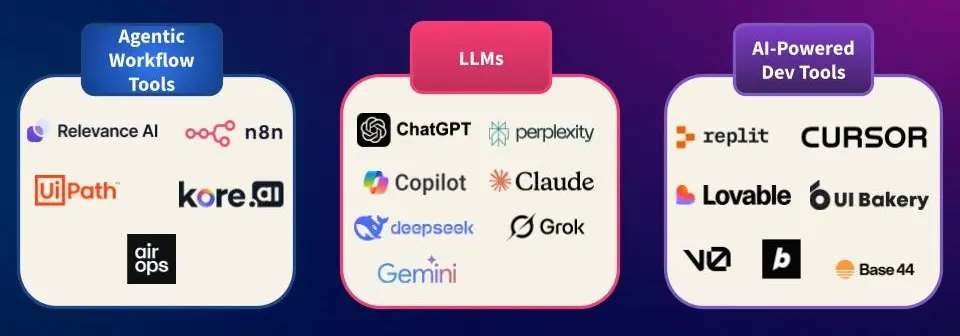
The tool ecosystem has scaled with unprecedented velocity, validating the permanence of the trend.
According to TechCrunch, Cursor surpassed $2 billion in annual recurring revenue by February 2026. The platform now supports over 1 million daily active users, penetrating half of the Fortune 500. Lovable hit $200 million ARR by November 2025 with nearly 8 million users, successfully launching mobile apps in April 2026. Replit secured a $400 million raise at a staggering $9 billion valuation in March 2026, boasting 50 million+ registered users.
- For Freelance and Consulting: Cursor is the industry standard. A modified VS Code environment with deeply integrated AI, the $20/month Pro tier offers an undeniable ROI for anyone billing $100+/hour.
- For Non-Technical Founders: Lovable and Bolt.new dominate. Lovable outputs complete React and TypeScript applications—frontend, backend, auth, and payments—purely from conversation. Bolt.new famously scaled from zero to $4 million ARR in 30 days, hitting 5 million users by mid-2025.
- For Complex Architecture: Replit Agent constructs full-stack applications from natural language, with their Agent 4 operating 10x faster than previous iterations via parallel-agent workflows.
- For Comprehensive Analysis: Consult GJ’s ranked list of the best 2026 vibe coding tools for granular breakdowns of pricing and use-case alignment.
Market Longevity: Is Vibe Coding a Sustainable Career?

The data confirms this is a structural shift, not a fleeting trend. Y Combinator managing partner Jared Friedman revealed that a quarter of the YC Winter 2025 batch operated codebases that were 95% AI-generated. YC CEO Garry Tan reinforced this, stating: “For 25% of the Winter 2025 batch, 95% of lines of code are LLM generated. That’s not a typo.”
The valuations reflect this reality. Cursor raised $2.3 billion at a $29.3 billion valuation. Replit sits at $9 billion. Lovable commands $6.6 billion. Cursor’s $2 billion ARR is generated by active developers writing production software.
Debating whether vibe coding is a “job title” completely misses the target. It is a capability multiplier. A marketer deploying custom landing pages autonomously is objectively more valuable. A consultant prototyping software live during a discovery call will close deals faster. A founder shipping an MVP over the weekend rather than burning $50,000 on an agency alters their entire risk profile.
The specific tool stack will inevitably evolve. Cursor may lose market share; Lovable might pivot. However, the foundational ability to describe logic and have software compile instantly is permanent. The operators generating immense revenue in 2026 aren’t debating career titles; they are isolating profitable problems, deploying rapid solutions, and collecting the invoices.



0 Comments