

Decoding ChatGPT-5.5 Capabilities for Power Users
OpenAI just shipped GPT-5.5, branding it as their most intuitive architecture and the first fully retrained base model since GPT-4.5. But marketing claims rarely survive contact with daily operations. To find out if the hype translates to actual utility, we need a rigorous test of the new ChatGPT-5.5 capabilities across real-world workflows.
The model is currently rolling out to Plus, Pro, Business, and Enterprise tiers within ChatGPT and Codex. A specialized variant, GPT-5.5 Pro, is restricted to upper-tier subscribers, while API access remains imminent. Crucially, OpenAI claims this intelligence leap incurs no speed penalty, matching the per-token latency of the previous generation.
The Core Upgrades: Autonomous Execution
OpenAI designed this model to execute messy, multi-step tasks independently. You can feed it ambiguous goals, and it will plan, select tools, verify its own output, and push through roadblocks. The most significant workflow disruptions are happening in four distinct areas:
- Agentic coding: Ship full features natively inside Codex, complete with deep repository context, automated debugging, and failure mode analysis.
- End-to-end computer use: The model can directly manipulate desktop software, email clients, and spreadsheets to automate administrative bottlenecks.
- Advanced knowledge work: Generate comprehensive reports, synthesize vast datasets, and execute complex web research autonomously.
- Scientific applications: Streamline complex technical pipelines, including data modeling for specialized fields like drug discovery.
💡 Pro-Tip for Automators:
You don’t need to wait for OpenAI to natively manipulate your desktop. You can build these exact email and spreadsheet automations right now using the ChatGPT API and [Make.com (Get 10,000 Free Operations Here)].
The Benchmark Battle: OpenAI vs. Claude Opus 4.7 vs. Gemini 3.1 Pro
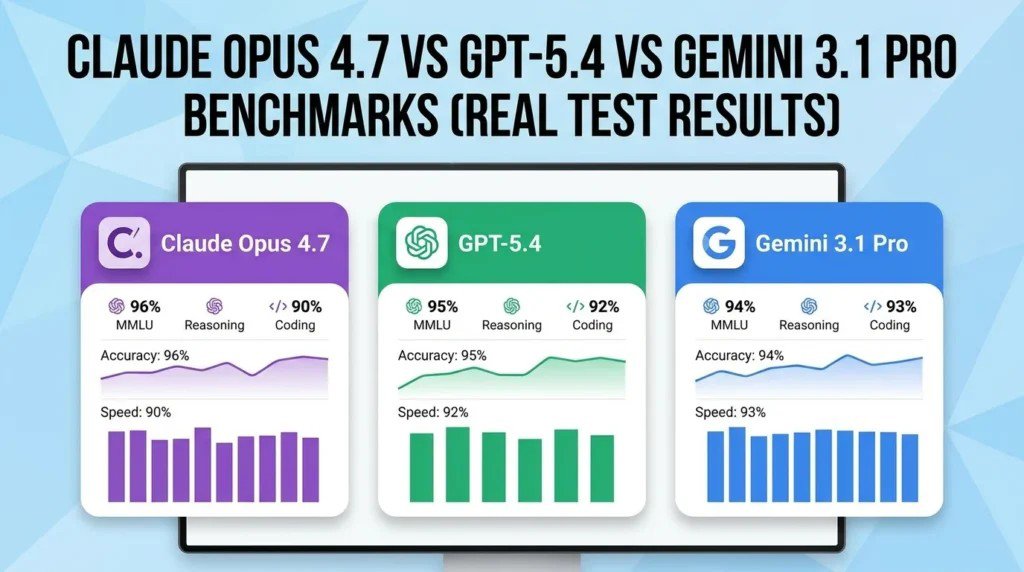
Synthetic benchmarks highlight a highly competitive, though fragmented, AI landscape. GPT-5.5 dominates Terminal-Bench 2.0 with an 82.7% score, comfortably crushing Claude Opus 4.7 (69.4%) and Gemini 3.1 Pro (68.5%).
It also posts aggressive numbers across OSWorld-Verified (78.7%) and GDPval (84.9%). However, it stumbles slightly on SWE-Bench Pro. Its 58.6% score falls short of the 64.3% set by Claude Opus 4.7 for software engineering tasks.
For deep web research, the GPT-5.5 Pro variant shines. It hits an impressive 90.1% on BrowseComp, edging past Gemini 3.1 Pro’s 85.9%.
Stop searching for free graphics. Supercharge your workflow with unlimited access to millions of high-quality vectors, stock photos, PSDs, and AI-generated assets on Freepik.
Stress-Testing ChatGPT-5.5 Capabilities: 5 Actionable Prompts
We ran five specific, high-friction prompts to test reasoning, context retention, and execution. Here is how the new architecture handled the pressure.
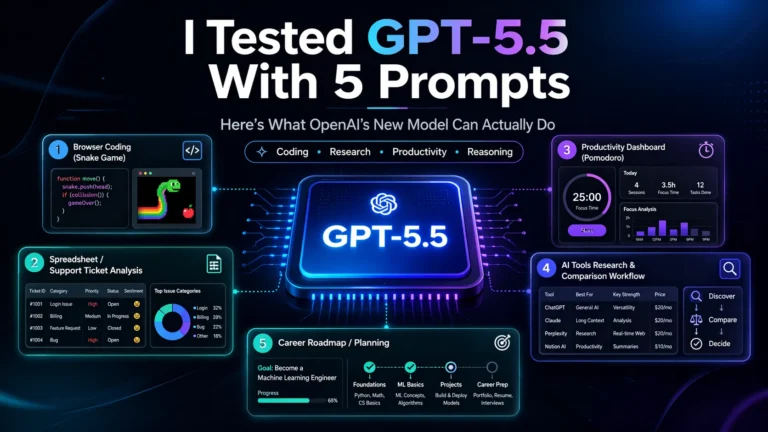
1. Vibe-Coding a Browser Game
The Prompt: Build a single-file HTML Snake game featuring rainbow segments, exponential speed scaling, and a ‘chaos mode’ that randomly inverts controls. We requested a local high-score tracker, retro CRT scanlines, and native Web Audio API sound effects.
The Verdict: The initial render required a minor CSS prompt to fix board visibility. Once corrected, the output was flawless. The gameplay remained lag-free, and the requested logic executed perfectly.

2. Automating Enterprise Data Analysis
The Prompt: Analyze a CSV containing 12 months of customer support tickets. We asked the model to cluster themes, identify the top three systemic issues, estimate financial impact, and output a prioritized executive memo.
The Verdict: The synthesis was crisp and corporate-ready. It entirely bypassed the need for manual spreadsheet parsing, delivering actionable, well-structured insights in seconds.
3. Building a Custom Productivity Dashboard
The Prompt: Code a distraction-free ‘Focus Dashboard’ in a single HTML file using only vanilla JS. Requirements included a customizable Pomodoro timer, drag-and-drop task management, a daily streak counter, local storage persistence, and a glassmorphism dark theme.
The Verdict: Zero corrections required. The model strictly adhered to the framework constraints and delivered a polished, immediately deployable utility tool.
🌐 Samuel’s Deployment Hack:
When ChatGPT-5.5 generates a raw web app or dashboard, don’t run it locally. We instantly deploy all our AI-generated tools on [Hostinger VPS (Get 70% Off + Free Domain)] so they are live on the web in seconds.
4. Multi-Tool Agentic Research
The Prompt: Audit the top five AI productivity tools launched in the past six months. We required a comparative spreadsheet tracking pricing, core features, and target demographics, alongside a 400-word editorial overview.
The Verdict: The model utilized its browsing and spreadsheet generation tools seamlessly. The resulting dataset was accurate, comprehensive, and formatted for rapid comparative analysis.

5. Navigating Career Ambiguity
The Prompt: Map a 9-month transition plan from product management to a technical AI role. The prompt demanded a 90-day learning roadmap and five portfolio project concepts, complete with resume bullets and honest difficulty scores.
The Verdict: This showcased the model’s advanced contextual memory and logical reasoning. It provided a highly personalized, pragmatic roadmap that accurately assessed technical difficulty without relying on generic career advice.
💻 The AI Power User Desk Setup:
Running advanced local code, managing API streams, and deep-focus work requires the right hardware. Samuel tests these AI models using the Logitech MX Master 3S for rapid workflow switching, and an Ultra-Wide Curved Monitor to keep terminal logs and ChatGPT windows open side-by-side.
The Final Verdict on OpenAI’s New Architecture
GPT-5.5 represents a substantial evolution in handling fragmented, multi-step digital workflows. It is a direct, forceful response to the rising capabilities of recent Anthropic and Google models.
To leverage these new features, users must manually enable ‘thinking mode’ within the interface, as the default Instant model remains locked to version 5.3. While enterprise developers will need to benchmark it against their specific tech stacks, everyday power users will immediately feel the upgrade in both code generation and workflow automation.



0 Comments